

When a Flyway Fell Silent: Omid and the Vanishing Memory of Migration
- Brishti

- Jan 24
- 4 min read
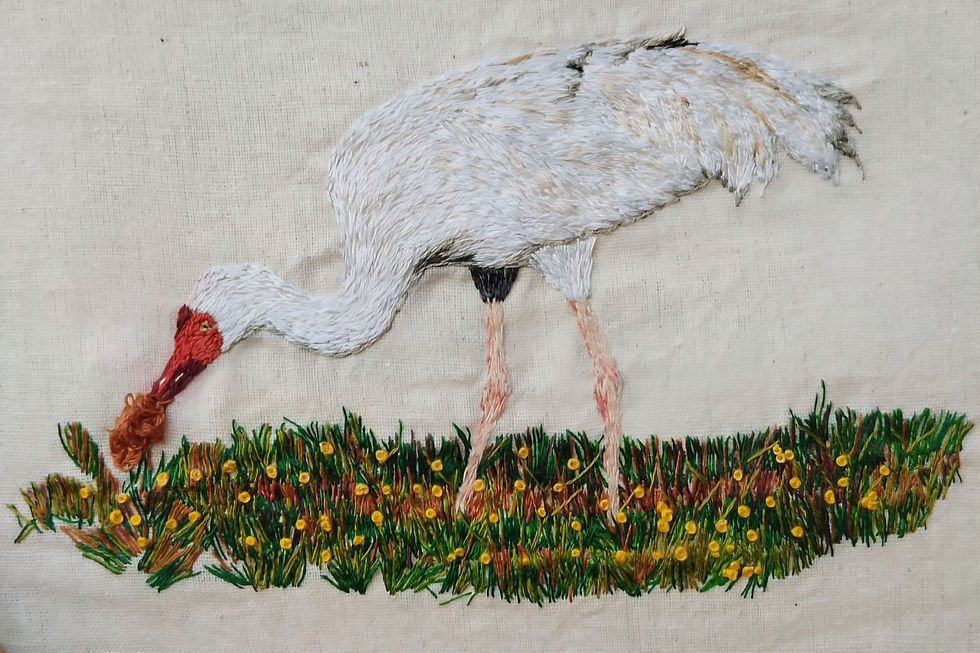
Omid’s story stands as one of the most moving and unsettling narratives in contemporary conservation. It is not merely the tale of a single bird, but of an entire migratory tradition slipping into extinction.
The Siberian crane (Grus leucogeranus) is a species shaped by the Arctic. It breeds in the remote tundra wetlands of northern Russia, spanning vast regions from Yakutia in the far east to western Siberia. Within this range, the species historically existed as three geographically and behaviourally distinct populations—western, central, and eastern—each bound to a separate migratory destiny.
These cranes are among the longest-distance migrants in the avian world, historically travelling thousands of kilometres between Arctic breeding grounds and temperate wintering wetlands in Asia. These journeys were once undertaken in flocks, sustained by inherited routes, collective memory, and a chain of healthy wetlands stretching across continents.


Historically, these three populations migrated along three principal Asian flyways, linking breeding grounds with wintering wetlands thousands of kilometres to the south. Over time, however, these flyways fractured.
The central population, which once wintered in the wetlands of northern India, collapsed due to sustained hunting pressure and extensive wetland loss and has been considered extinct since the early 2000s.
The eastern population, migrating to China and wintering primarily in the Yangtze River floodplain, is now the only self-sustaining group, numbering approximately 5,000–6,000 individuals. Even this population remains under serious threat from dam construction, altered river hydrology, wetland degradation, and accelerating impacts of climate change.
The western population followed a different path—one that ended on the southern shores of the Caspian Sea in Iran. It was within this population that Omid emerged as a singular figure.
Omid belonged to the last remnants of the western flyway, migrating between western Siberia and the coastal wetlands of northern Iran. His route began in the Arctic tundra of Yakutia, where shallow wetlands and permafrost-fed marshes support breeding during the brief summer. As winter approached, he travelled thousands of kilometres south, crossing vast stretches of Russia, the Caspian region, and rugged landscapes before reaching the coastal wetlands of northern Iran, particularly around Fereydunkenar on the southern edge of the Caspian Sea. This journey required not only physical endurance but also precise ecological timing—safe stopover wetlands, predictable weather, and undisturbed feeding grounds.
For many years, Omid completed this journey alone, becoming the only known surviving member of his population and an emblem of both resilience and loss.
Omid was alone because the western population of Siberian cranes has been effectively erased. Over several decades, relentless hunting along migration corridors, large-scale drainage of wetlands, dam construction, agricultural expansion, and infrastructure development dismantled the ecological network these birds depended on. Climate change intensified these losses by altering hydrological cycles, drying wetlands, disrupting freeze–thaw patterns in breeding areas, and making weather conditions increasingly unpredictable during migration.
As habitats disappeared, the cranes vanished gradually—some killed during migration, others unable to complete their journey when traditional stopover sites failed. With no surviving mate arriving at the wintering grounds, Omid could not reproduce. He was not separated from the others by distance or chance; the others are gone. Their absence is the result of cumulative environmental collapse rather than a single catastrophic event. Omid survived through instinct and resilience, but his isolation revealed how easily complex ecological networks can unravel.
The name “Omid”, meaning hope in Persian, was given to him by local conservationists and communities in Iran. The name reflects both optimism and desperation: hope that this ancient migratory instinct has not entirely vanished, and hope that attention drawn to a single bird might protect what remains of fragile wetland ecosystems. Omid was special because he embodied the final living thread of a once-thriving migration system. Each year, Omid made an extraordinary migratory journey of up to 5,000 kilometres, flying south from his remote breeding grounds and returning to the Fereydunkenar wetlands in Mazandaran province - a route that no longer functions as a living system. These wetlands are internationally recognized for their biodiversity and have been an important wintering site for Siberian cranes since the 1970s.
In early 2023, conservationists introduced a captive-reared female crane named Roya (Persian for dream) in the hope that she could pair with Omid and help revive the dwindling western population. For a short period, the two cranes wintered together in Iran and departed northwards in spring, raising rare optimism about a possible resurgence.
However, neither Omid nor Roya was subsequently observed on migratory routes after spring 2023, and concerted monitoring efforts failed to confirm their return to wintering grounds. By the end of 2023, Omid had not been seen in his traditional wintering season, triggering concern among ornithologists that he may have perished during or after migration. This absence is widely interpreted to mean that the western population is now functionally extinct, with no confirmed individuals remaining in the wild.
Omid’s disappearance underscores the profound challenges facing long-distance migratory species. The loss of the western flyway reflects centuries of habitat degradation, unregulated hunting, and climate-induced changes to wetland hydrology that have fractured once-reliable ecological networks. Without intact stopover sites and stable wintering grounds, even the instinctual memory of migration cannot compensate for the absence of viable habitat.
Today, the Siberian crane remains Critically Endangered, with its future tied primarily to the eastern flyway and ongoing international conservation efforts. Omid’s legacy endures as both a symbol of loss and a call to action: the disappearance of an entire migratory population is a stark reminder that species conservation requires not only protecting individuals, but also safeguarding the ecological routes that sustain them.


An unsettling reality of the time we are living in. This thought-provoking article truly deserves appreciation for the facts, for its pace, and above all for the call of action that it stirs. And what a master-stroke to cage this tragic tale in an embroidery artwork!!!
Feeling sad for them. And they must be eating plastic and dying everywhere. Humans just keep sympathetic names but don't really do anything concrete about it.
I hope it attaches in the comment section
Despite the conviction that the article has been written after a good amount of research and that the maps are so helpful in understanding the migration routes, one question lingers in my mind.
Did you make the art piece after knowing the hardships being faced by the birds or the reverse?