

Whispers from the Columns: The Slow Fade of Andul Rajbari's Grandeur
- Brishti

- Feb 5
- 4 min read

Imagine stepping off a dusty train at Andul station on a golden afternoon, the kind where the winter sun in Bengal feels like a gentle hand on your shoulder. A short rickshaw ride later, through narrow lanes and the faint scent of river air, you round a corner—and there it stands: Andul Rajbari, rising like a dream half-remembered from another century, a mix of Indo-European architecture.

Its colossal Doric columns, towering and proud, catch the light first. Once gleaming white and gold, they now wear the patina of time—cracked plaster revealing brick beneath, vines creeping up like slow, green fingers reclaiming what was theirs. Yet even in decay, the facade commands awe: a grand symmetrical sweep of arched windows, ornate balconies framed by delicate balustrades, and pediments carved with floral motifs that whisper of craftsmen who labored with love and precision.

The grand main gate—once a triumphant portal welcoming zamindars, dignitaries, and festival processions—now stands barricaded and firmly shut, its iron bars rusted and chained, a silent barrier against intruders and the passage of time itself. Beyond it, the narrow lanes of Andul twist like capillaries through the neighbourhood, forcing locals to cut across the palace grounds as a convenient thoroughfare. What was once a private royal expanse—vast lawns for evening strolls and grand assemblies—has become an impromptu shortcut: villagers pedal bicycles through the open field, children chase each other across the patchy grass, and daily footfall erodes the dignity of the soil that once knew only reverent steps.
This quiet appropriation underscores the palace's fall from seclusion to accessibility—its boundaries blurred not by design, but by neglect and necessity. The barricade protects what's left inside, yet the grounds outside, unguarded and open, bear the constant tread of ordinary life, turning heritage into a forgotten pathway in the rhythm of modern Andul.
This is no ordinary mansion. Built in 1834 by Raja Rajnarayan Roy Bahadur (also referred to as Raja Rajnarayan Raybahadur), a descendant of the influential Roy zamindar family—whose lineage included Ramlochan Roy, dewan to Lord Clive and Warren Hastings—the palace, locally known as Anandadhaam or Anandadham, emerged during the height of Bengal's zamindari era. Constructed over the period of 1830–1834 with involvement from the Granville Macleod Company, it spans about 10 bighas (roughly 10 acres) and once boasted more than a hundred rooms. In its prime, it was a cultural powerhouse: marble dance floors in the naach mahal echoing with music and footsteps, Belgian chandeliers scattering light across frescoed ceilings, grand Durga Puja celebrations with processions to the nearby Saraswati River (now vanished, though traces of its old course linger in the landscape). The Mitra family, current residents alongside a local girls' school in parts of the property, are among the descendants who still hold fragments of this legacy.
Walk (carefully) through what remains of the verandas, and you can almost hear the laughter of long-ago soirées. The architecture sings a unique duet: lofty pillars built with lakhori bricks—a Mughal-era technique of thin, burnt-clay bricks—supporting neoclassical grandeur inspired by European Palladian styles. Behind the main structure stand the Annapurna Temple and twin Shiva temples in classic atchala Bengal style, their spires still drawing devotees amid the quiet devotion.
But step closer, and the spell breaks.

Peeling plaster clings in ragged patches, exposing the delicate lakhori brickwork beneath—those thin, red Mughal-era bricks that once formed the sturdy bones of the pillars and walls, now laid bare like forgotten secrets.
Weeds and wild grasses thrust defiantly through fissures in the cracked plaster, marble thresholds, and even the fractured floors, turning grand corridors into accidental gardens of neglect.


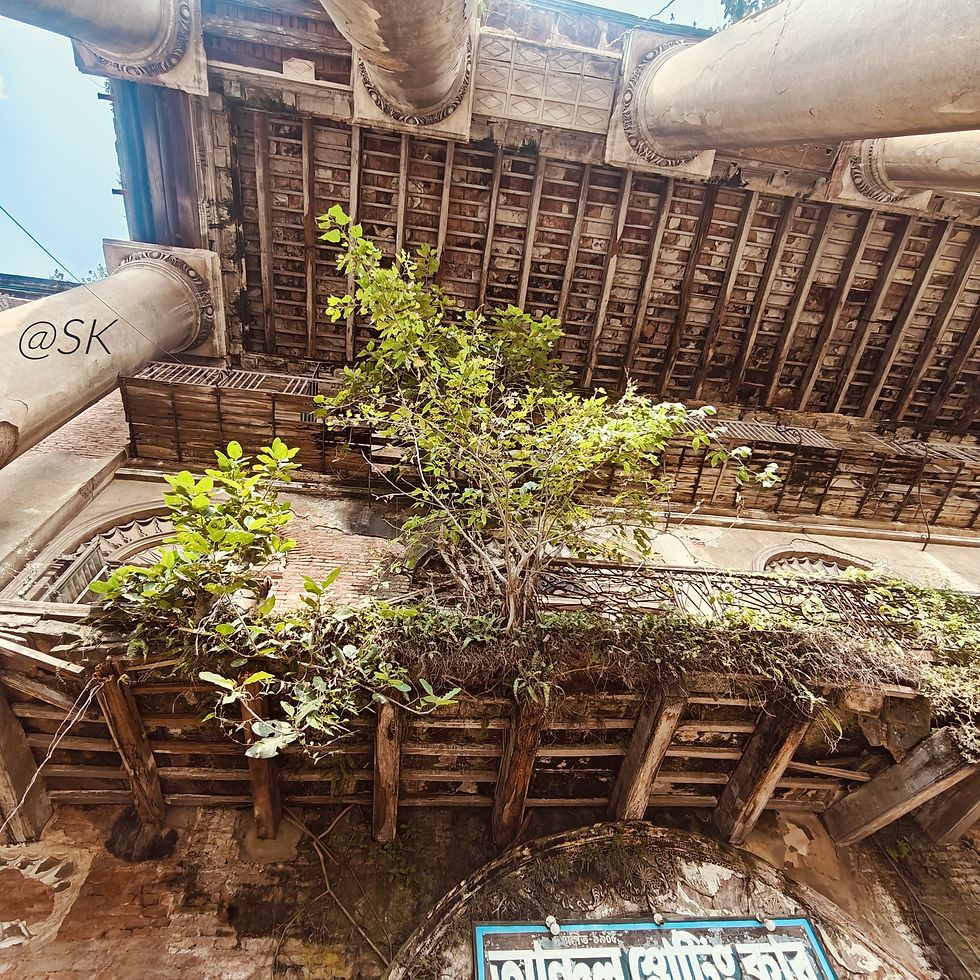
The once-pristine lawns, manicured for royal promenades and festive gatherings, have surrendered to patchy, barren earth strewn with scattered litter—plastic wrappers, broken tiles, and the quiet debris of time.
Most poignantly, the naach mahal's roof collapsed decades ago—perhaps over fifty years back, under the weight of relentless monsoons and unchecked decay—leaving its soaring Corinthian pillars to stand sentinel over an open void, framing nothing but endless sky and the heavy ache of what was lost.
Government authorities have declared sections, like the naach mahal, dangerous and unsafe, yet no substantial restoration has followed. A handful of descendants and tenants cling to livable corners, while promoters eye the land, encroachers have settled in, and rooms are quietly rented out. Rain seeps into foundations year after year, accelerating the ruin. This isn't mere neglect—it's a slow, silent theft of our shared heritage, with the palace listed on heritage-at-risk registers and described by conservation voices as crumbling due to prolonged apathy.

It's heartbreaking. This isn't just a dilapidated building; it's a masterpiece begging to breathe again. Imagine guided walks through restored halls, light festivals illuminating the columns at dusk, schoolchildren learning history of the place not from textbooks but from standing beneath those same arches where zamindars once hosted gatherings. It could become Bengal's hidden gem for thoughtful travellers, a living bridge between past and present—especially since it's already recognised as a heritage site by local authorities and promoted for its cinematic history (it served as a backdrop for classics like Saheb Bibi Golam).

Yet without urgent intervention—restoration supported by government bodies, heritage organisations like INTACH, or passionate community efforts—it may not survive another generation. The pillars that have stood for nearly two centuries could become rubble, the stories silenced forever. The Rajbari is a material archive of Bengal’s socio-political history. Its loss would erase tangible evidence of zamindari governance, colonial-era architectural adaptation, and regional craftsmanship.
As you leave with a heavy heart, turning back for one last look, the palace seems to gaze back: majestic, wounded, still impossibly beautiful. It asks a quiet question: Will we let this chapter of Bengal's soul fade into dust, or will we write the next one—together?


I strongly felt that our government should focus on protecting our heritage.
Is some part of it still in use?